
The modern digital economy loves to market a single, intoxicating promise: 100% absolute automation. We are constantly told that by plugging Artificial Intelligence into every corner of our business, we can scale infinitely while remaining completely detached from daily operations.
While AI is an incredible operational multiplier, the narrative of the flawless, hands-free business is a dangerous illusion. True digital scale isn’t just about maximizing operational speed—it is about maintaining system integrity. When you remove human oversight completely, you introduce a mathematical decline in output quality that eventually destroys profit margins.
Let’s break down the actual operational framework and the hidden math behind this reality.
1. The Operational Tech Stack: Where to Automate Strategically
Before looking at the failures, we must understand how a sustainable automated system should look. AI should be integrated into specific, repetitive friction points to save time, not to replace the founder’s brain. A mature digital tech stack utilizes these specialized tools:
- Workflow Orchestration (Make.com & Zapier): These act as the nervous system of your digital business. They seamlessly connect your website, CRM, and accounting tools via APIs, moving data and invoices instantly without manual human entry.
- Data Analytics & Operations (Polymer & Pandas AI): Instead of staring at messy spreadsheets, these engines parse complex database clusters to instantly identify customer buying habits and predict product demand cycles.
- Immediate Customer Support (ManyChat & Intercom): Advanced LLM-driven chat systems handle first-tier support queues by instantly resolving simple queries, checking delivery timelines, or offering product FAQs 24/7.
2. The Equation of Failure: The Math Behind “Fake Work”
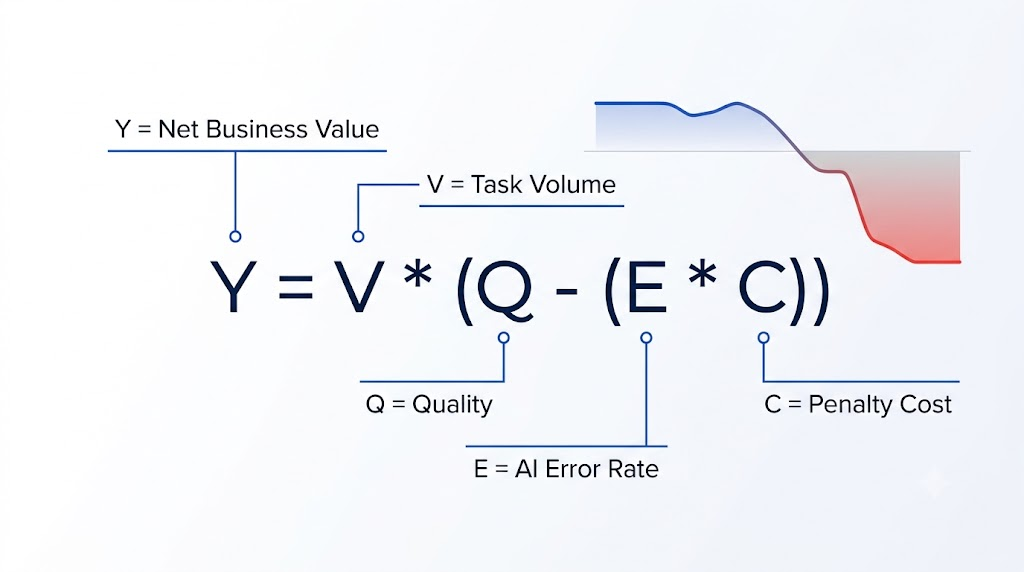
Why does a business running entirely on automated scripts eventually collapse? It comes down to a simple mathematical relationship between Volume ($V$), Baseline Human Quality ($Q$), and the AI Error Rate ($E$).
Let the Net Strategic Value ($Y$) of your business output be modeled by the following equation:
$$Y = V \times (Q – (E \times C))$$
$$Y = V \times (Q – (E \times C))$$
Where:
- $V$ = Volume of tasks executed (e.g., generating 500 AI blog posts, bulk-sending 10,000 scraped emails, or letting a bot handle 1,000 customer tickets).
- $Q$ = Baseline quality value of a human-verified, highly strategic asset.
- $E$ = The Error or Hallucination rate of the AI system over long runs (which increases without human prompt tuning).
- $C$ = The compounding penalty cost of a failure.
The Operational Breakdown ($Y < 0$):
When you automate 100% without a human anchor, your volume ($V$) goes up drastically because AI can work infinitely fast. However, because the system is completely unattended, the AI error rate ($E$) compounds.
The moment the penalty of those mistakes ($E \times C$) becomes greater than the baseline quality ($Q$), the bracketed value turns negative. When you multiply a massive volume ($V$) by a negative number, your net business value ($Y$) crashes below zero.
You are effectively producing a massive volume of superficial output that actively destroys your business. This is the definition of “Fake Work.”
3. Real-World Case Studies of the Automation Trap
- The Content & SEO Collapse: Generating hundreds of unedited AI articles scales your volume ($V$) high. However, search engines actively penalize unoriginal, low-effort programmatic content. The penalty ($C$) is the total loss of organic traffic, tanking your domain authority to zero.
- The Customer Support Blindspot: Setting unregulated AI bots to handle complex billing issues or user complaints. When the bot encounters an anomaly, it hallucinates—making false billing promises or legal compliance errors. The cost ($C$) is severe financial loss and ruined customer trust.
- The Domain Blacklist: Running automated cold email outreach sequences without human monitoring of sender reputation scores. Spam filters instantly flag the automated loops, permanently blacklisting your corporate email domains.
True scaling is an optimization problem, not an elimination problem. AI is engineered to increase your operational volume ($V$), but human intuition, auditing, and strategic adjustments are required to keep the error rate ($E$) at zero. Keep your hands firmly on the strategic steering wheel to ensure your systems generate sustainable profit, not digital noise.